A Philosophical Revolution in Education
Mastery learning represents a radical challenge to the traditional school. While conventional education accepts as natural that some students excel and others fail, this approach rests on a profoundly different conviction: virtually all students can reach high levels of learning when they are given the appropriate conditions and the time they need.
The Theoretical Roots
In 1963 John B. Carroll put forward a revolutionary idea: the degree of learning depends on the ratio between the time a student spends learning and the time they actually need. Instead of regarding aptitude as a fixed ability, Carroll reconceptualized it as the time needed to learn something under optimal conditions.
Benjamin S. Bloom turned this insight into a concrete teaching system. Analyzing research on one-to-one tutoring, he found that students taught by an expert tutor achieved results two standard deviations higher than students in traditional classes. The question became: how can the effectiveness of one-to-one tutoring be replicated in a group setting? The answer was mastery learning.
The Fundamental Pillars
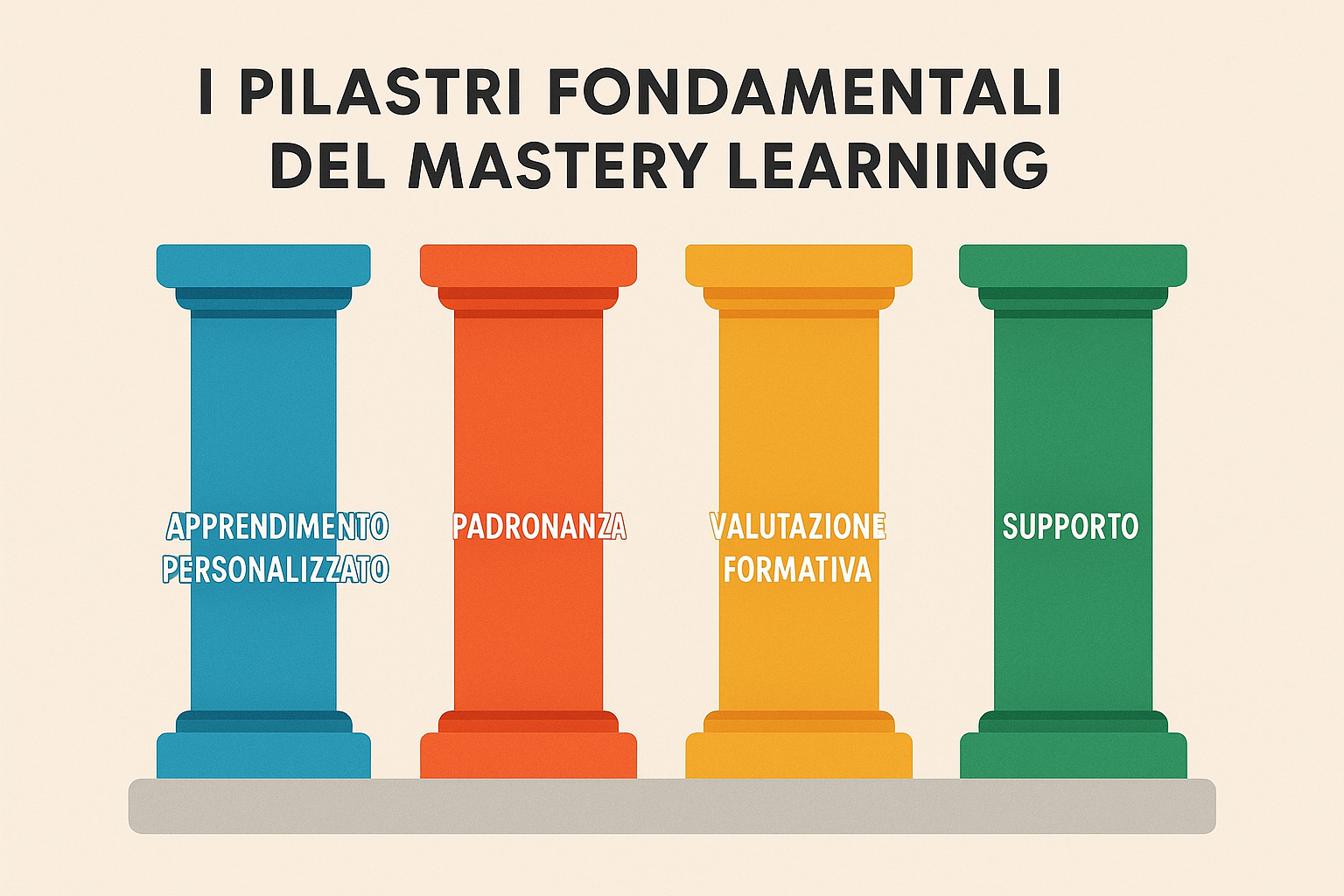
The first essential element is perfect alignment between learning objectives, teaching activities and assessment. In mastery learning, every component is synchronized: students know exactly what they must learn, instruction is designed specifically for those objectives, and assessment measures precisely what has been taught.
The second pillar is the cycle of feedback, correction and enrichment. After each teaching unit, students take a diagnostic assessment that provides precise information about what they have learned well and where difficulties persist. Results are communicated quickly, not in terms of comparison with classmates but in relation to the objectives. Students are then grouped according to their needs: those who have not reached mastery receive targeted corrective instruction using different approaches, while those who have demonstrated mastery engage in enrichment activities. Finally, everyone completes a summative assessment that determines whether they have met the mastery criterion, typically 80-90% correct answers.
Turning the Paradigm Upside Down
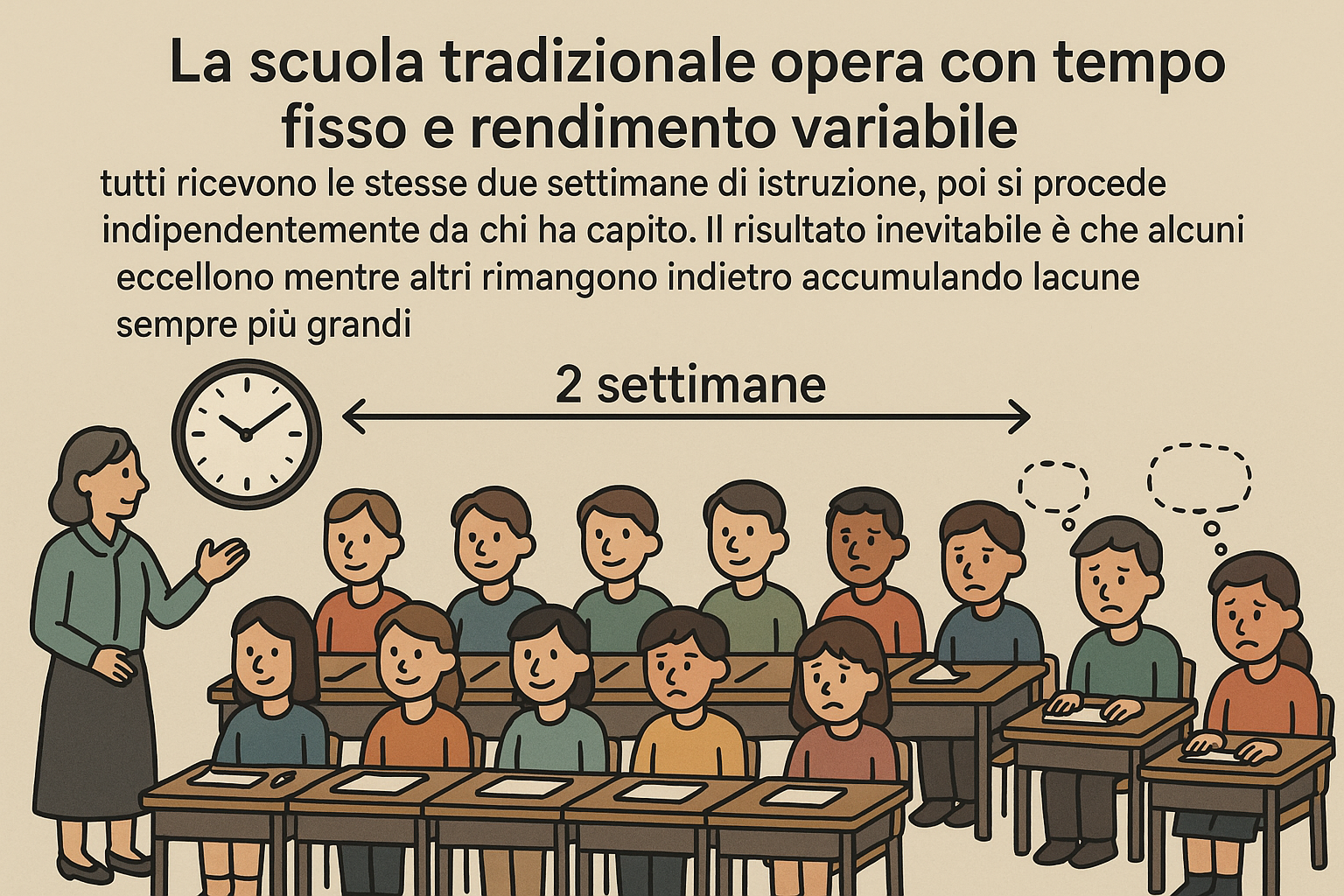
The traditional school operates with fixed time and variable achievement: everyone receives the same two weeks of instruction, then the class moves on regardless of who has understood. The inevitable result is that some excel while others fall behind, accumulating ever larger gaps.
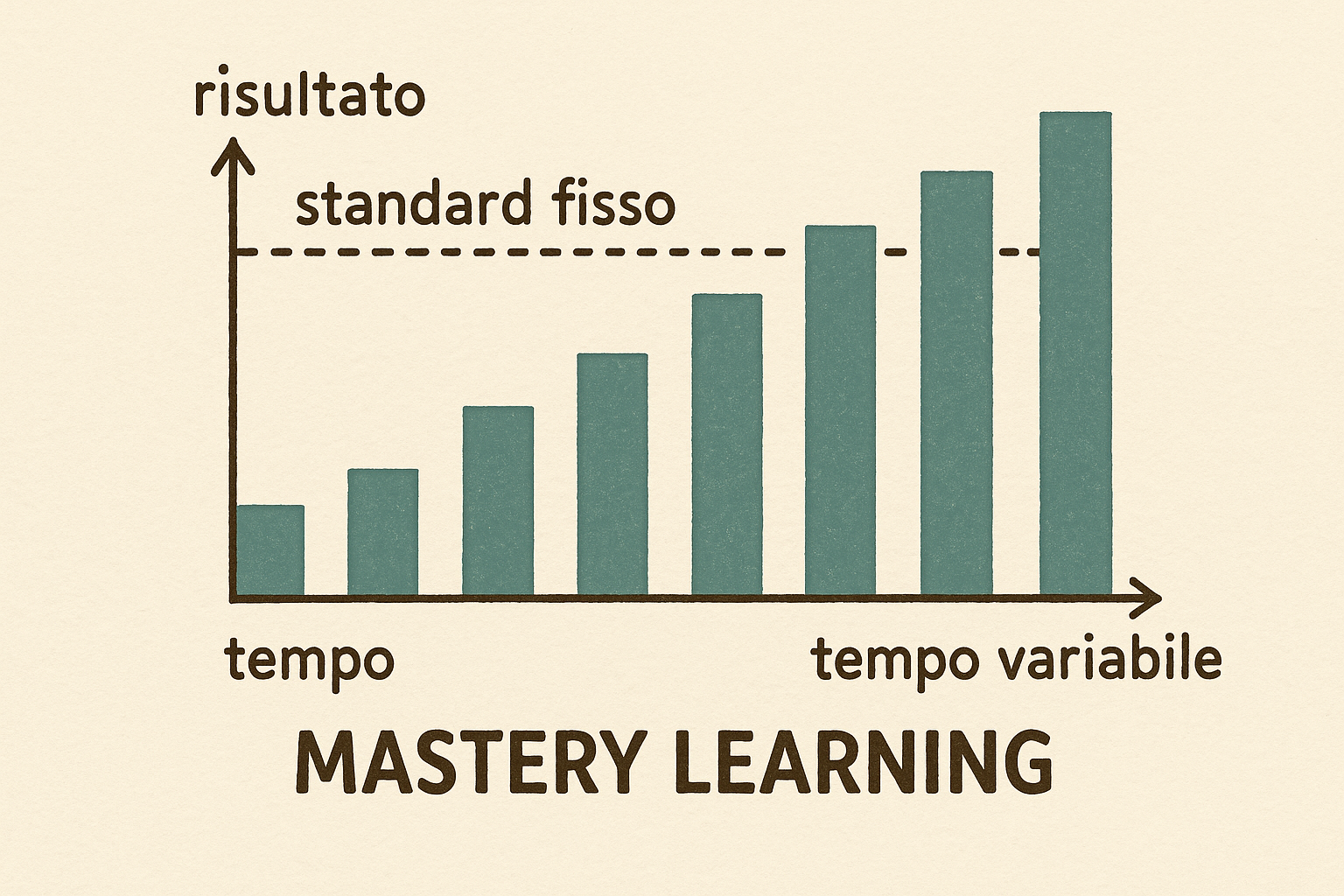
Mastery learning turns this paradigm upside down: fixed standards, variable time. Everyone must reach the same high level of mastery, but some get there faster and others need more time. The underlying philosophy holds that the differences lie in the time and conditions needed to learn, not in the ultimate ability to do so. This approach challenges deficit-based thinking: instead of labelling students as “slow” or “less able”, it asserts that almost everyone can learn excellently when the system adapts.
The Scientific Evidence
Decades of research show impressive results. Kulik’s meta-analyses of 108 studies found average improvements of about 0.5 standard deviations compared with traditional instruction, while Guskey and Pigott found even stronger effects, up to 0.78 standard deviations for well-implemented programmes. The benefits are particularly marked for students with the greatest initial difficulties, helping to narrow achievement gaps.
The impact goes beyond academic achievement: more positive attitudes towards subjects, greater confidence in one’s abilities, less performance anxiety and a transformation in the identity of the student, who repeatedly experiences success instead of chronic failure. The effects are particularly strong in hierarchically structured subjects such as mathematics, science and foreign languages, where each new piece of learning builds on the previous one.
The Challenges of Implementation
The challenge of time is crucial: in an already overloaded curriculum, where can extra time for corrective instruction be found? A real tension emerges between covering many topics superficially and ensuring deep mastery of fundamental ones.
Assessment is another significant challenge. Creating valid, diagnostic formative assessments takes time and expertise, as does developing parallel forms of tests to prevent answers from being memorized. Teachers must interpret the results to pinpoint exactly where each student’s difficulties lie.
At the organizational level, managing a class in which students work simultaneously on different activities requires sophisticated management skills and a reorganization of space and materials. At the systemic level, traditional grading systems conflict with the philosophy of mastery learning: if the goal is for 80% to reach an excellent level, how can this be reconciled with normal curves or with the pressure to differentiate for university admissions?
Book in Progress AI: Mastery Learning in Practice
In the Italian landscape of educational innovation, Book in Progress AI is a concrete example of how technology can embody the fundamental principles of mastery learning. Born at the ‘E. Majorana’ Institute in Brindisi, the system takes the form of a national network of teachers combining artificial intelligence, interactive content and continuous formative assessment.
The platform integrates continuous formative assessment that allows students to constantly measure their level of learning, receiving precise information about what they have mastered and where they still need to work. The heart of the system lies in personalization, which takes the form of eight different document structures to suit different cognitive styles and an AI-based support system that lets students request explanations, summaries, deeper insights and translations. If a student does not understand a concept presented in one way, the platform can present it again through alternative structures, exactly as the correction phase of mastery learning envisages.
Book in Progress AI allows students to progress at their own pace, perfectly embodying the fundamental principle: variable time to reach fixed standards. The platform also offers coding and 2D/3D simulation environments for STEM teaching, which are particularly effective as enrichment activities for students who have already achieved mastery.
The attention to accessibility reflects the democratic conviction of mastery learning: specific tools for students with special educational needs, a text-to-speech system, tools to improve readability, concept maps and slides demonstrate that all students can reach high levels when the system adapts to their needs.
The platform provides teachers with essential tools: an advanced authoring system, AI-based chat and content generation to rapidly develop diversified corrective materials, and a system for generating simulations and animations. These tools address one of the greatest challenges of mastery learning: the time needed to create valid formative assessments and diversified corrective materials.
Book in Progress AI is not just a technological platform but a network of teachers and schools collaborating to write the content. This approach addresses another critical challenge: isolated implementation by individual teachers is difficult, whereas system-wide adoption makes the process enormously easier. The network dimension allows best practices to be shared, materials to be developed collectively and mutual support to be given.
The commitment to making personalized learning affordable, with the project to be released as Open Source, reflects the ethical dimension of mastery learning: if we believe that all students can reach high levels, we must make sure the tools are accessible to everyone.
Technology at the Service of Educational Philosophy
The platform shows how technology can tackle the practical challenges of mastery learning at scale: the AI provides immediate corrective support, the authoring tools cut the time needed to create assessments, the system automatically manages individualized paths, and continuous formative assessment provides immediate feedback.
Book in Progress AI is an illuminating example of how technology should be used in education: not to replace fundamental pedagogical principles, but to make them finally achievable in everyday practice. The platform takes the proven principles of mastery learning and makes them accessible, scalable and sustainable for teachers and students, turning the conviction that all students can excel from an aspiration into a concrete reality in Italian classrooms.
An educational philosophy, recognized internationally
In May 2026 IISS Ettore Majorana in Brindisi won the AI Transformation category of the Varkey Foundation’s Global Schools Prize, out of almost 3,000 applications from 113 countries, precisely for the work described on this page. Find out who is behind the project or become part of the network.